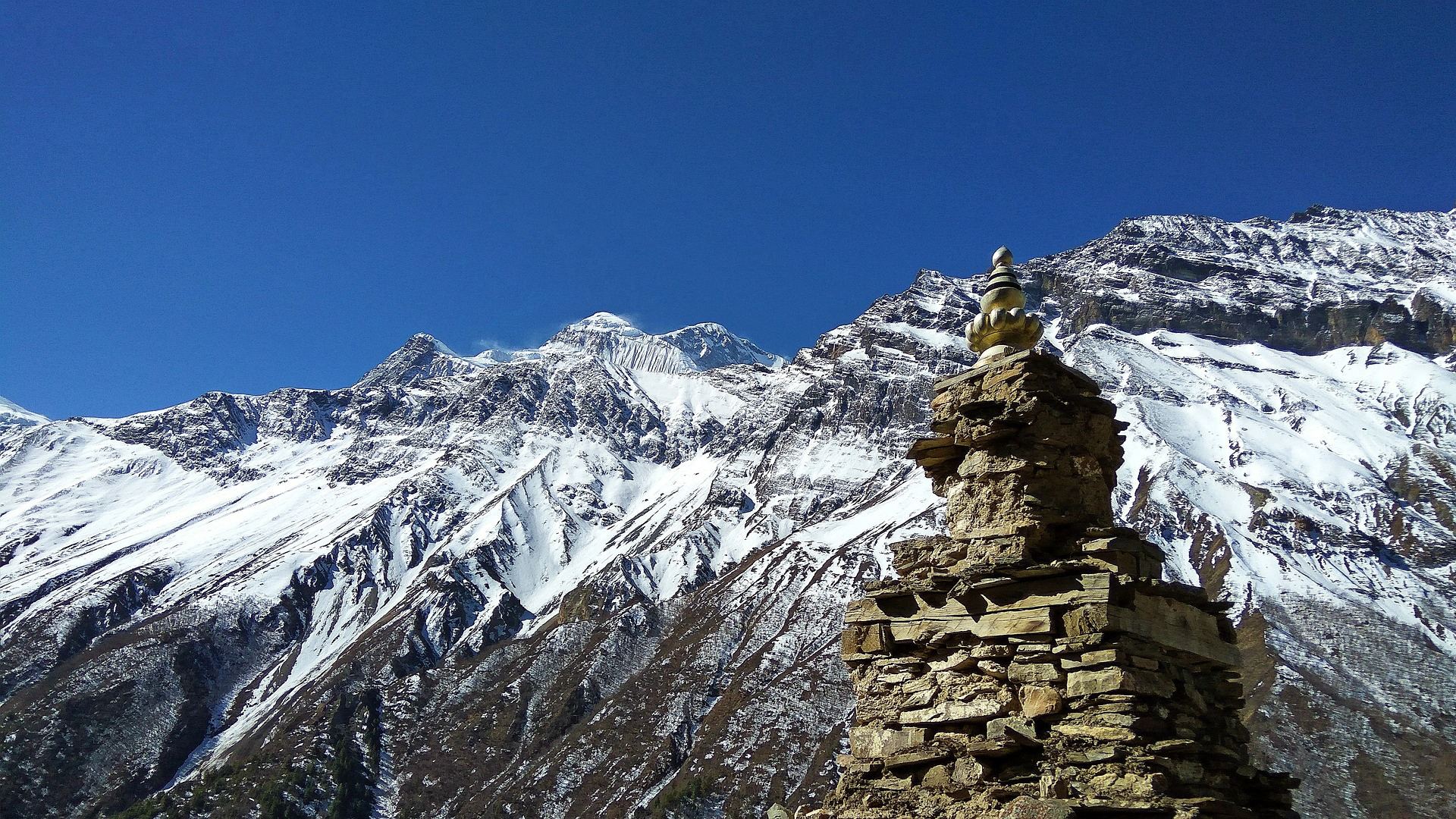
A small stone stupa against a ridge of snowy mountains. You pass shrines like this often on Himalayan village roads.
Nepal is only about 200 km from north to south, yet its southern plains sit around 100 m above sea level while its northern border is lined with giants, Everest (about 8,849 m) among them. Eight of the world's fourteen peaks over 8,000 m are in Nepal.
Many hill villages are linked by dirt jeep roads, which suits an e-MTB that helps you up the climbs. You can stop at roadside tea houses, sleep in village lodges and wake up to the sun rising over the snow peaks.
This guide centres on the signature Annapurna Valley Loop and covers five regions, including Pokhara, the Kathmandu Valley, Bandipur and Lumbini, with the roads and sights of each.
Jomsom and Muktinath, Mustang · about 2,700–3,700 m
Annapurna Valley Loop
- Distance
- 25–50 km per day
- Time
- 3–4 days
- Surface
- Dirt and gravel jeep roads
- Level
- Intermediate to advanced
The Kali Gandaki River runs along the western side of the Annapurna massif. With Dhaulagiri (about 8,167 m) and Annapurna I (about 8,091 m) rising on either side, the valley is often counted among the deepest gorges in the world. It lies north of the main range and gets little rain, so instead of green forest you find dry rocky mountains and a wide gravel riverbed.
The loop is based in Jomsom (about 2,700 m). Ride out to Marpha, a village full of apple orchards, then follow the river north through the old village of Kagbeni and climb to the pilgrimage site of Muktinath (about 3,700 m) before coming back down to Jomsom. Most of the way is dirt and gravel jeep road, ideal for a fat-tyred e-MTB.
You reach Jomsom from Pokhara by small plane or by jeep. Because the route starts high, spend the first day on short rides to nearby villages such as Marpha while you adjust to the altitude.
Things to see
Muktinath
A pilgrimage site sacred to both Hindus and Buddhists. Its temple has 108 spouts pouring icy water. Park the bike and walk around the temple area.
Kagbeni
An old village of mud-walled houses and narrow lanes that twist like a maze. North of here begins Upper Mustang, which needs a separate permit.
Marpha
A tidy village of whitewashed stone houses and paved lanes. The orchards make it famous for apple pie, apple juice and apple brandy.
Thakali meals
The food of the Thakali people of this valley: rice and lentil soup (dal bhat) with several side dishes, very welcome after a long day on the bike.
Pokhara, Gandaki Province · town about 800 m, Sarangkot about 1,600 m
Pokhara Lakeside and Sarangkot
- Distance
- 30–60 km per day
- Time
- 1–2 days
- Surface
- Paved road plus village tracks
- Level
- Intermediate
Pokhara sits beside Phewa Lake, the second largest lake in Nepal. On clear days the Annapurna range and the fishtail summit of Machhapuchhre (about 6,993 m) look close across the water. At about 800 m the climate is mild, and the town is the starting point for trips into the Annapurna region.
The flat lakeside road is a good place to get used to the bike. The main ride climbs to Sarangkot on the ridge north of the lake, gaining about 800 m to a wide Himalayan view at the top. On the way down you can pick dirt tracks between hillside villages.
On a second day, ride east to Begnas Lake. It is quieter than Phewa, and the road through rice fields and villages is relaxed.
Things to see
Sunrise at Sarangkot
Get up before dawn to watch the Annapurna peaks turn red one by one. Later in the day paragliders launch from here and circle over the lake.
World Peace Pagoda
A white stupa on the hill south of Phewa Lake. From the front of the stupa the lake, the town and the snow peaks fit into one view.
Tal Barahi Temple
A Hindu temple on a small island in Phewa Lake. You cross by rowing boat from the shore.
Begnas Lake
A quiet lake east of Pokhara. The lakeside tea houses are a good place for a break.
Kathmandu and Bhaktapur, Bagmati Province · about 1,300–2,100 m
Temple Roads of the Kathmandu Valley
- Distance
- 40–60 km per day
- Time
- Day trip or overnight
- Surface
- Paved road plus ridge tracks
- Level
- Intermediate
The Kathmandu Valley is a wide bowl ringed by hills, home to three old cities: Kathmandu, Patan and Bhaktapur. Seven of its palace squares, temples and stupas together form a UNESCO World Heritage site, so there is a lot to see within a short distance.
The valley floor is at about 1,300 m. Climb toward the rim and the noise and dust of the city give way to terraced fields and hill villages. A classic ride goes from Bhaktapur past the hilltop temple of Changu Narayan and up to Nagarkot (about 2,100 m) on the eastern ridge.
Spend a night in Nagarkot and, on a clear morning, you can see the Himalaya stretching along the northern horizon. The next day, take a different road back down into the valley and on to Kathmandu.
Things to see
Boudhanath Stupa
One of the largest stupas in Nepal. Painted eyes look out in every direction from above the white dome, and pilgrims walk around it clockwise. Explore the area on foot.
Bhaktapur old city
An old city of red brick buildings and carved wooden windows. The five-roofed Nyatapola temple stands on its square, and the city is known for juju dhau, a rich yoghurt.
Changu Narayan
One of the oldest Hindu temples in the valley, waiting at the top of a hill climb. Its stone and wood carvings are finely detailed.
Nagarkot viewpoint
A village on the ridge at the eastern edge of the valley. At sunrise the Himalayan range glows red.
Tanahun, Gandaki Province · about 1,000 m
Bandipur, an Old Town on the Ridge
- Distance
- 30–50 km per day
- Time
- 1–2 days
- Surface
- Paved climb plus village tracks
- Level
- Beginner to intermediate
Bandipur is a small town between Kathmandu and Pokhara, perched on a ridge above the main road. It was once a trading stop for merchants travelling between India and Tibet, and the brick houses and wooden windows built by the Newar people still line its street.
A winding climb leads up to the town from Dumre on the main road below. The gradient is hard work on a regular bike, but on an e-MTB you will only break a light sweat, and the valley and terraced fields open up below as you climb.
The main street is closed to cars, so it is calm and pleasant on foot. Dirt tracks follow the surrounding ridges, good for short rides to neighbouring villages, and the town makes a good one or two-day break between Kathmandu and Pokhara.
Things to see
Bandipur's old street
Each brick house has a small shop or tea house on the ground floor. In the evening locals and travellers come out to chat in the street.
Tundikhel
A broad grassy hilltop at the edge of town. On clear days the snow peaks of the Himalaya stretch along the northern horizon.
Thani Mai Temple
A small temple on the hilltop above town. It is a short walk up, and many people go for the sunrise.
Siddha Cave
One of the larger caves in Nepal. It is reached by walking down a hill path from town, so leave the bike behind. It is dark inside, so bring a torch.
Rupandehi, Lumbini Province · about 100 m
Lumbini, a Pilgrim Ride on the Plains
- Distance
- 20–40 km per day
- Time
- 1–2 days
- Surface
- Flat paved roads
- Level
- Beginner
Lumbini is revered as the birthplace of the Buddha and is a UNESCO World Heritage site. It lies on the southern plains (the Terai) near the Indian border, where the roads are flat, which is rare in mountainous Nepal.
Inside the sacred area, temples built by many countries are spread out on either side of wide gardens and a long canal. The distances are too large to cover comfortably on foot, so many visitors get around by bike. With an e-MTB you can visit many temples without wearing yourself out in the heat.
It works well as a rest day between mountain rides, or as an easy final day after your Himalayan riding.
Things to see
Maya Devi Temple
Named after the Buddha's mother, the temple covers the spot held to be his birthplace. Beside it are a pond and a large tree hung with prayer flags.
Ashoka Pillar
A stone pillar raised by the Indian emperor Ashoka when he visited in the 3rd century BC. Its inscription records this as the Buddha's birthplace.
Temples of many nations
The monastic zone holds Buddhist temples built by many countries, and comparing their styles is half the fun. There is a Korean temple, Dae Sung Shakya Sa, too.
Good to know before you go
When to go
October to April. October and November, just after the monsoon, have the clearest skies. December to February is clear but cold up high. In March and April the national flower, rhododendron (lali guras), blooms on the hillsides. June to September brings heavy rain, muddy roads and frequent landslides.
Altitude and weather
Muktinath is at about 3,700 m, high enough for altitude symptoms. Avoid big jumps in sleeping altitude, drink water often, and go down if a headache gets worse. Pokhara and Lumbini are warm, but high villages drop below freezing on winter nights.
Roads and bikes
Main roads are paved, but roads to hill villages are mostly dirt and gravel. Traffic drives on the left. It is safer to cover busy highways by car and ride the hill roads. Some mountain lodges have limited power, so charge whenever you can.
Food
Dal bhat, rice and lentil soup with side dishes, is the everyday meal. Also try momo dumplings, thukpa noodle soup and sel roti, a ring-shaped rice bread. Roadside tea houses serve sweet milk tea (chiya).
Money and signal
The currency is the Nepalese rupee (NPR). Some places in cities take cards, but villages and lodges are often cash only. Mobile signal is good in towns and along main roads, patchy deep in the mountain valleys.
Entry and safety
Entry rules vary by nationality and change over time, so check with the embassy before you go. Conservation areas such as Annapurna and the national parks need entry permits, and rules on travelling with a guide can change, so check ahead. Always wear a helmet and ride with at least one other person.
On Nepal's roads the snow peaks are always in the background. Catch your breath at a tea house at the top of a climb, wave back to village children as you pass, and the day goes by fast. Leave a spare day in your plan so you can wait for a morning when the clouds clear.
Need a bike for these roads?
Pick your dates and we'll show the e-MTBs you can rent.