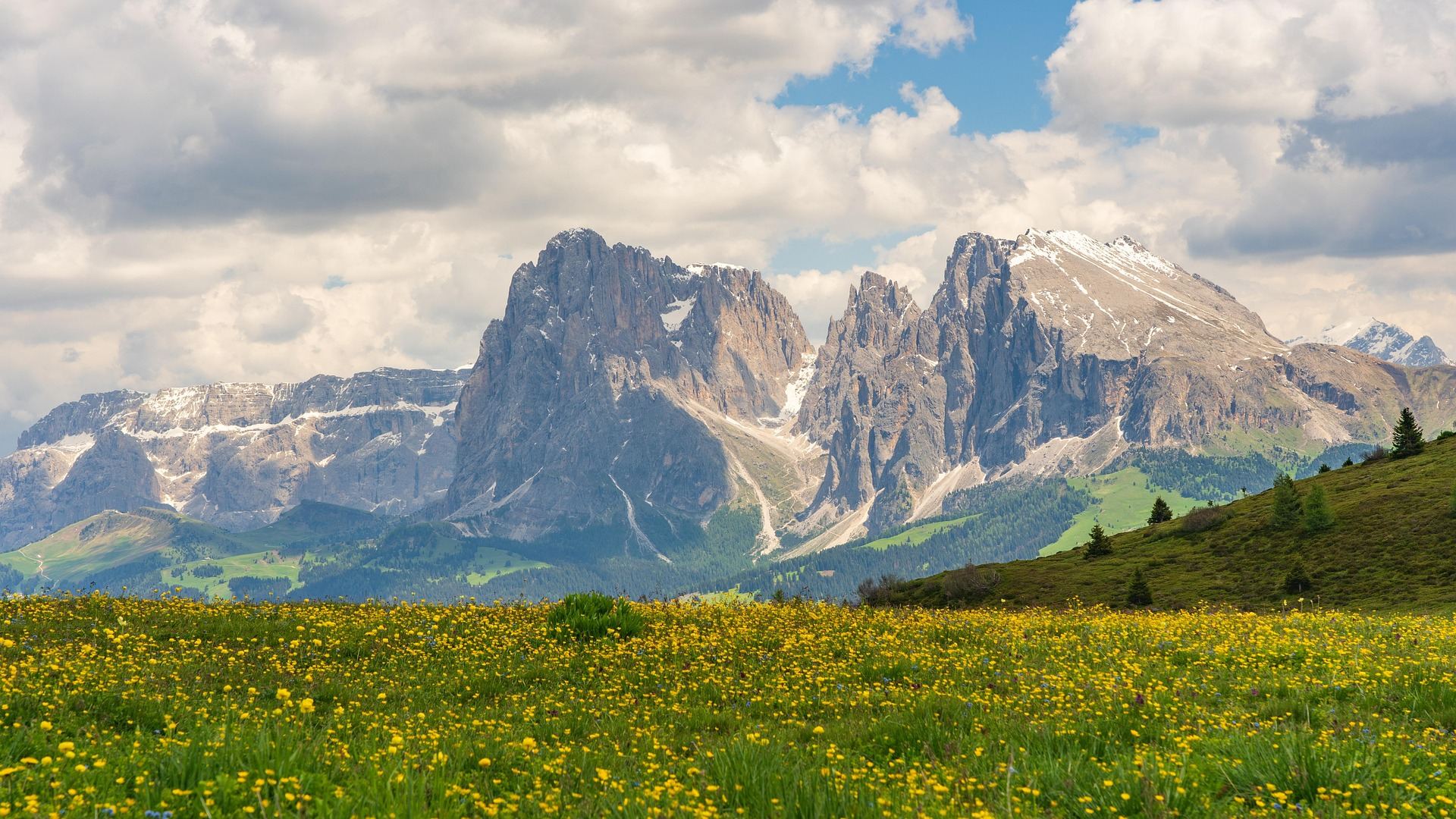
Dolomite rock towers rising beyond a meadow of yellow wildflowers. Summer in northern Italy starts with views like this.
Italy is wrapped in the Alps to the north, and the Apennines run down the length of its boot. In between lie large lakes carved by glaciers, hills covered in vineyards and olive groves, and coastline on three sides. Travel a day or two and the landscape changes completely.
This is the country of the Giro d'Italia, a bike race held for more than a hundred years, so cyclists are a normal sight on mountain passes and country lanes, and every village has a café to stop at. An e-MTB that helps on long climbs lets you take on famous passes without strain, with energy left over for gravel and forest tracks.
This guide centres on the signature Lake Garda Ridge Loop and covers five regions: Garda, the Dolomite passes, Lake Como, the vineyard roads of Tuscany and the coastal hills of Liguria, with the roads and sights of each.
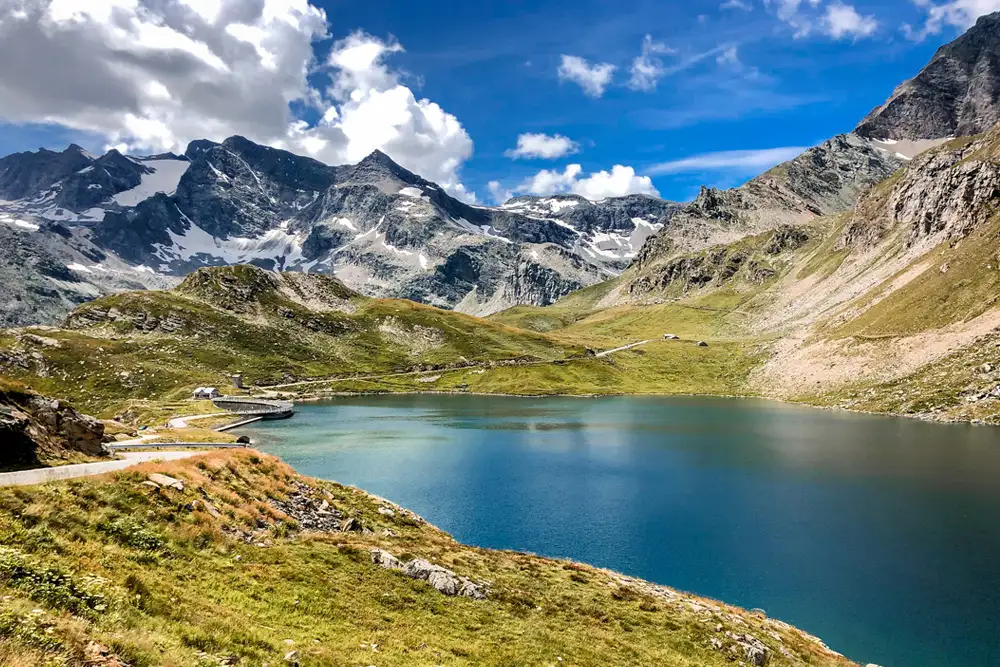
Trentino · Riva del Garda and Arco, lake at about 65 m
Lake Garda Ridge Loop
- Distance
- About 60 km (about 1,100 m of climbing)
- Time
- Day trip
- Surface
- Paved road plus an old gravel road
- Level
- Intermediate to advanced
Garda is Italy's largest lake. Its southern end opens onto a wide flat plain, but the northern tip is long and narrow, pushed in between mountains that rise like cliffs on both sides. Riva del Garda and Arco at the northern tip are among Europe's best-known mountain bike towns, with plenty of bike rental shops, workshops and hotels that store bikes.
The signature route leaves the lakeshore and climbs onto the cliffs on the west side. You ride up the old Ponale road, cut into the cliff face in the 19th century, watching the lake drop away below, loop around Lake Ledro high above, and then come back down to the shore. There is a lot of climbing for the distance, which makes it tough on a regular bike, but on an e-MTB you can ride it in a day if you spread the battery out.
On days with energy to spare, add Lake Tenno north of Riva or the castle at Arco. The wind here often blows from the north in the morning and from the south in the afternoon, which has made the lake famous for windsurfing. If you ride along the shore in the afternoon, plan for a headwind.
Things to see
The old Ponale road
A gravel road running along the side of the cliff. It is closed to cars, so only walkers and cyclists use it, and every bend opens a view over the northern end of the lake.
Lake Ledro
A mountain lake at about 650 m. Remains of prehistoric pile dwellings on its shore make it one of the sites in the UNESCO World Heritage listing 'Prehistoric Pile Dwellings around the Alps'.
Arco Castle
A castle on top of a rocky hill above olive groves. The town below is also famous for rock climbing, and watching the climbers is a good excuse for a break.
Lake Tenno
A small turquoise lake hidden in the woods. It pairs well with a short visit to the old stone village of Canale nearby.
Trentino-Alto Adige and Veneto · passes at about 1,875–2,244 m
Four Dolomite Passes
- Distance
- About 55 km (about 1,700 m of climbing)
- Time
- Day trip
- Surface
- Paved pass roads
- Level
- Advanced
The Dolomites are a range of huge pale limestone peaks rising above forest and meadow, listed as a UNESCO World Natural Heritage site in 2009. At their centre stands the Sella group, ringed by four passes: Gardena, Sella, Pordoi and Campolongo. The loop over all four is a ride many cyclists hope to do at least once.
All four passes are above 1,800 m, and between each one the road drops to a village and climbs again. On a regular bike it takes all day; on an e-MTB you can do it in a day if you keep the assist low on each climb. Asking to charge while you rest at a pass-top restaurant or village café also helps.
In these valleys people speak Italian, German and an old language called Ladin, which is why village signs often show two or three names. Climb a pass around sunrise and the rock towers glow pink while the roads are still quiet, so many riders set off at that hour.
Things to see
Pordoi Pass
One of the four passes. A cable car from the top climbs to a viewpoint at about 2,950 m, and on a clear day you can see the glacier on the Marmolada (about 3,343 m), the highest peak in the Dolomites.
Sella Pass and the Sassolungo
From the top of the pass, the huge rock wall of the Sassolungo stands right in front of you. A good place to stop for photos before the descent.
Corvara and Alta Badia
Valley villages between the Gardena and Campolongo passes where Ladin culture lives on. A good place for lunch and a rest.
Mountain hut food
Huts (rifugi) near the passes serve canederli bread dumplings, smoked speck ham and apple strudel.
Lombardy · Bellagio, about 200–750 m
Lake Como and the Ghisallo
- Distance
- 30–60 km per day
- Time
- 1–2 days
- Surface
- Paved road
- Level
- Intermediate
Lake Como is shaped like an upside-down Y and is one of the deepest lakes in Europe. Steep slopes run right down to the water, and colourful houses, old villas and gardens fill the narrow strip of land between. Bellagio, on the point where the lake's three arms meet, is where this route begins.
About 10 km of climbing south of Bellagio brings you to the Madonna del Ghisallo. It is a regular climb in Italian bike races, and the small chapel at the top is known for its patron saint of cyclists. The view down over the lake from the chapel is lovely too.
The lakeside roads are narrow, with many tunnels and heavy traffic in summer. Skip the busiest stretches by taking a ferry that carries bikes, and enjoy seeing the lake from the water as well.
Things to see
Madonna del Ghisallo chapel
Bikes and jerseys donated by famous racers hang inside the chapel. There is a cycling museum right next door.
Bellagio
A village of stone-stepped lanes and lakeside promenades, with old villas and fine gardens close by.
Varenna and the ferry
A small village across the water from Bellagio, with colourful houses pressed against the shore. The crossing is short, so it fits easily into a day.
Tuscany · Chianti and Val d'Orcia, about 250–600 m
The White Roads of Tuscany
- Distance
- 40–70 km per day
- Time
- 2–3 days
- Surface
- Gravel (strade bianche) plus paved road
- Level
- Intermediate
Chianti, between Florence and Siena, and the Val d'Orcia south of Siena are the classic Italian countryside. Vineyards, olive groves and rows of cypress trees line the soft hills, and a stone village sits on almost every hilltop. The Val d'Orcia is a UNESCO World Heritage site for its landscape alone.
Many of the country roads here are strade bianche, 'white roads' of pale earth and gravel. L'Eroica, an event where people ride these roads on vintage bikes, began in Gaiole in Chianti, which shows how closely these roads are tied to cycling. A fat-tyred e-MTB rolls up and down the gravel hills with ease.
The hills are short, steep and never-ending, so there is more climbing than the map suggests. Villages are close together, which suits a slow pace: two or three stops a day, lunch in a square and a visit to a winery.
Things to see
Pienza
A small town rebuilt in the Renaissance as an 'ideal city', with a historic centre on the UNESCO World Heritage list. It is known for pecorino, the local sheep's milk cheese.
Montalcino
A fortified hilltop town and home of Brunello, one of Italy's best-known red wines.
Bagno Vignoni
A small spa village whose main square is a large stone pool filled with thermal water.
Chianti villages
Small villages such as Gaiole, Radda and Castellina are scattered among the vines. Wine with the black rooster seal is the area's Chianti Classico.
Liguria · Savona area, sea level to about 1,000 m
Finale Ligure: Trails Above the Sea
- Distance
- 20–40 km per day
- Time
- 1–3 days
- Surface
- Dirt trails and forest roads
- Level
- Intermediate to advanced
Finale Ligure is a small town on the Ligurian coast west of Genoa. Limestone hills and woods rise straight up behind the beach, and a dense network of mountain bike trails on those hills has made it one of Europe's favourite mountain bike destinations.
Most trails are rocky dirt paths, so this is the most technical of the five regions. In return, the fun of climbing a forest road to the top on an e-MTB and riding back down through the woods with the Mediterranean below is hard to beat, and the motor saves enough energy for several laps a day.
Being by the sea, it stays fairly mild even in winter, so you can ride here when the Alps are under snow. After a ride you can rest on the beach, then have dinner in an old walled village.
Things to see
Finalborgo
An old village with its medieval walls still standing. Restaurants and bike shops fill its narrow lanes and squares.
Manie plateau
Woods and fields on a hill above the sea. The trails are fairly gentle, which makes it a good place to get used to riding here.
Roman bridges of Val Ponci
Several stone bridges that once carried a Roman road still stand in a wooded valley.
Varigotti
A small village of colourful old fishermen's houses right on the beach. A good place for a swim after riding.
Good to know before you go
When to go
May to September. The Dolomite passes are best from June, once the snow has gone, to around September. Tuscany and the Ligurian coast are very hot in midsummer, so spring and autumn are more comfortable there.
Weather
In the northern mountains, showers and thunderstorms are common on summer afternoons, and the passes are chilly even in midsummer. The lakes and Tuscany get hot by day in summer, so start early and rest through the middle of the day.
Roads and bikes
Pass roads and lakeside roads are mostly paved but busy with cars and motorbikes. Trail rules for bikes differ from region to region, and some hiking paths are closed to bikes, so stick to signed bike routes. Many mountain huts and cafés are happy to help you charge an e-MTB.
Food
Every region eats differently. Try canederli and speck in the Dolomites, risotto with perch on Lake Como, thick pici pasta and ribollita bread soup in Tuscany, and focaccia and basil pesto in Liguria. An espresso in a village café makes a good break on any ride.
Money and signal
The currency is the euro (EUR). Cards work almost everywhere, but carry some cash for small huts and country shops. Mobile signal is good in towns and along main roads, with gaps in deep mountain valleys.
Entry and safety
Italy is in the Schengen area. Entry rules vary by nationality and change over time, so check with the embassy before you go. The emergency number is 112. Always wear a helmet, and keep your lights on in tunnels and on pass roads, even by day.
In Italy, whichever road you choose ends at a village, a café and a good meal. Sitting in a square after crossing a pass is part of the trip. Rather than packing too many kilometres into each day, leave room to linger in the places you like.
Need a bike for these roads?
Pick your dates and we'll show the e-MTBs you can rent.